

Huawei Laser’s 800W Desktop Laser Cutting Machine Brings Three Metal Processes Into a Compact Platform
Huawei Laser has expanded the company’s sheet-metal equipment range with an 800W Desktop Laser Cutting Machine. The compact design combines cutting, marking, and engraving functions within a desktop-format platform for workshops, studios, and production areas where floor space carries operational value.
The launch reflects a broader development in metal processing: laser equipment no longer belongs only to large factory floors. A compact fiber laser cutting machine for sheet metal can place digital metal processing closer to design, prototyping, repair, and short-run production teams while retaining a machine-centered workflow.
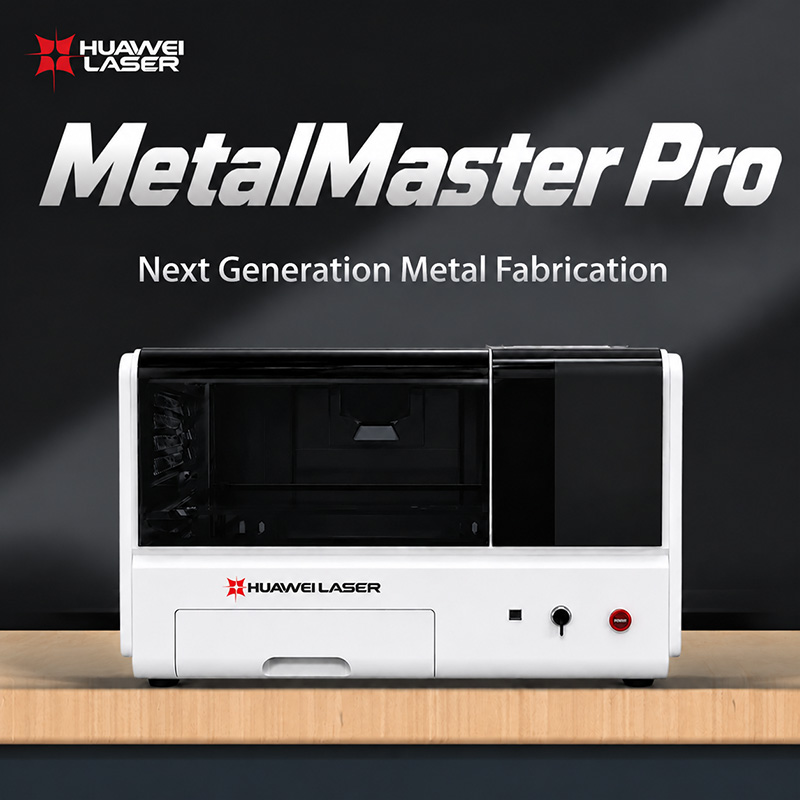
The Compact Machine structure
The 800W Desktop Laser Cutting Machine uses a space-saving structure intended to reduce the physical separation between digital design and finished metal parts. Huawei Laser describes the machine as a compact solution with straightforward operation and broad material compatibility.
Desktop architecture changes the role of a fiber laser cutting machine for sheet metal. Instead of occupying a dedicated large-format production zone, the machine can become a focused workstation for smaller components, customized pieces, prototypes, labels, panels, and limited production batches.
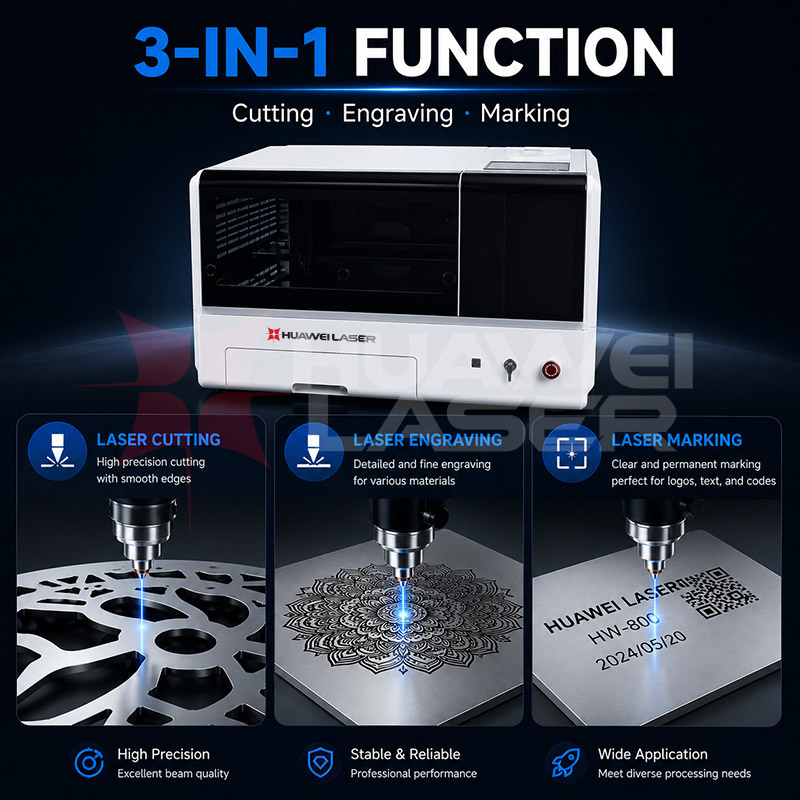
Three Processes Inside One Platform
Cutting forms the primary production function. A focused laser beam follows programmed paths to separate metal along defined geometry. Digital control supports straight lines, curves, holes, slots, text outlines, and nested shapes without requiring a dedicated physical die for every new design.
Marking adds permanent identification or visual information to a metal surface. Serial numbers, part codes, logos, scale lines, symbols, and traceability data can become part of the same digital workflow. Integrated marking can reduce transfers to a separate labeling station.
Engraving removes or modifies surface material to create deeper visual or functional features. Nameplates, control panels, decorative elements, identification plates, and customized metal components can benefit from a combined cutting and engraving sequence.
The three-function configuration gives the 800W platform a different role from a single-purpose machine. A fiber laser cutting machine for sheet metal with cutting, marking, and engraving capability can support a complete small-part sequence from outline creation to surface information.
Fiber Laser Processing at Desktop Scale
Fiber laser processing directs concentrated energy through an optical system toward a controlled point on the workpiece. Motion control guides the beam along a digital path, while process settings influence energy delivery, movement, and interaction with the selected metal.
Material type, thickness, surface condition, geometry, focus, speed, and assist-gas configuration influence the final result. A compact frame does not remove the need for disciplined parameter control. Stable settings remain central to edge condition, dimensional consistency, heat input, and repeatable production.
The 800W rating places the desktop system in a compact processing category rather than the high-power large-format category. Huawei Laser also produces open-type, exchange-platform, full-protection, and large-format sheet-metal systems, giving the desktop model a distinct position within a wider equipment family.
Where the 800W Desktop System Fits
The compact platform can serve metal signage, customized nameplates, equipment labels, electrical panels, decorative parts, repair components, educational demonstrations, design verification, and prototype development. Small manufacturers can also use the system for limited batches where frequent file changes matter more than continuous large-sheet throughput.
A fiber laser cutting machine for sheet metal can connect CAD-based design work with physical production. The connection supports rapid iteration for product developers, fabricators, maintenance teams, and creative metalworking businesses. Digital geometry also makes repeated production easier after an approved file and process recipe are established.
The desktop system does not replace every larger laser cutter. Large sheets, thick plate, automated material handling, and continuous industrial output belong to different equipment classes. The 800W machine instead concentrates three processing capabilities within a smaller footprint and a narrower production envelope.
Equipment Design Focuses on Workflow Versatility
Huawei Laser’s 800W launch highlights versatility as the central equipment story. Cutting creates the component outline, marking adds readable information, and engraving introduces surface depth or decoration. The shared platform can keep multiple operations aligned with one digital production file.
The compact design may also make laser processing accessible to teams previously separated from large industrial equipment. Product designers can evaluate metal forms, repair teams can reproduce small components, and customization businesses can combine shape creation with permanent branding.
A modern fiber laser cutting machine for sheet metal increasingly functions as a digital manufacturing node rather than an isolated cutting tool. File preparation, parameter control, material handling, processing, inspection, and design revision form one connected cycle around the machine.
Huawei Laser Extends the Sheet-Metal Product Family
The new desktop system broadens Huawei Laser’s sheet-metal portfolio from industrial open and enclosed formats toward a compact multifunction platform. The development gives the 800W Desktop Laser Cutting Machine a clear identity: a smaller machine built around precise digital control and three closely related metal processes.
For technical details, application guidance, sample processing, or project discussions concerning a fiber laser cutting machine for sheet metal, click here to contact Huawei Laser . Huawei Laser can review materials, drawings, part dimensions, and processing goals to recommend a suitable equipment configuration.