
Can The Handheld Laser Welder Weld Aluminum?
Aluminum is a popular choice in industries like automotive and aerospace due to its light weight and strength. But when it comes to welding, aluminum presents unique challenges. This raises the question: can you laser weld aluminum? The answer is yes, but the process isn’t straightforward. Despite the challenges, laser aluminum welding is becoming more common as new technologies emerge.
Why Is Aluminum Difficult to Laser Weld?
Aluminum conducts heat rapidly. The surrounding material can draw energy away from the joint, especially at the beginning of a weld or when processing thicker components. Insufficient energy may result in shallow penetration or incomplete fusion.
At the same time, aluminum has a relatively low melting temperature. Once sufficient energy reaches the joint, the material can melt quickly. An unsuitable combination of laser power and travel speed may therefore cause burn-through, undercut, or an unstable weld pool.
Aluminum also develops a natural oxide film. The oxide layer has a much higher melting temperature than the base metal and can trap moisture or contamination. Poor surface preparation can therefore contribute to porosity and incomplete fusion.
These characteristics do not prevent handheld laser welding. These characteristics make material preparation and parameter development essential.
Understanding the Aluminium Laser Welding Process
The aluminium laser welding process uses a focused laser beam to melt and fuse aluminum pieces. Unlike traditional welding methods, which rely on an electric arc, laser aluminum welding uses light energy to create a precise and controlled weld. The laser’s power, speed, and focus must be carefully adjusted to ensure a strong bond. Aluminum has a high thermal conductivity, which means it dissipates heat quickly. Thus the laser needs to be powerful enough to maintain a stable weld pool. Shorter wavelengths are usually better. Because they are more easily absorbed by aluminum, they are more suitable for laser welding aluminum alloys.
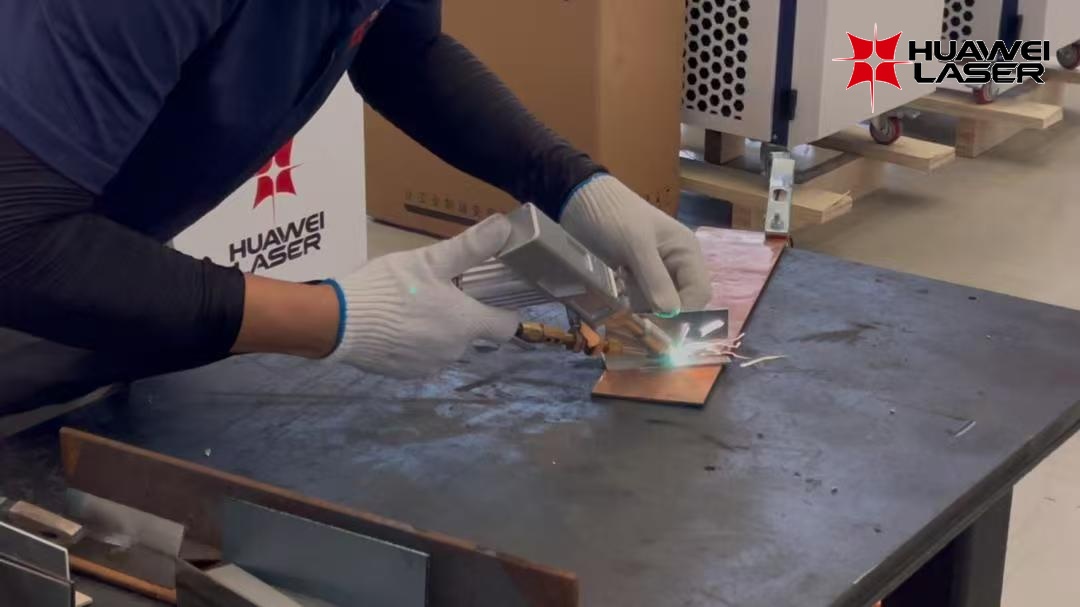
The Challenges of Laser Welding Aluminum Alloys
Laser welding aluminum alloys is challenging for several reasons.
First, aluminum has high reflectivity, which means it reflects much of the laser’s energy, reducing the efficiency of the welding process. This can also cause damage to the laser equipment.
Second, aluminum’s high thermal conductivity causes heat to dissipate quickly, making it difficult to maintain the necessary temperature for a strong weld. This can lead to problems like incomplete fusion and weak welds.
Additionally, aluminum forms an oxide layer on its surface, which has a higher melting point than the base metal. This layer must be removed or penetrated to achieve a strong weld.
Finally, some aluminum alloys are prone to cracking during the aluminium laser welding process, making it essential to choose the right alloy and adjust the welding parameters accordingly.
What Shielding Gas Is Required?
Argon is the usual starting point for shielding aluminum welds. The shielding gas protects the molten metal from the surrounding atmosphere and helps reduce oxidation and porosity.
Gas purity, flow rate, nozzle position, and coverage are all important. A high displayed flow rate does not guarantee effective shielding. Excessive flow can create turbulence and pull surrounding air into the protection zone.
Drafts from fans, open doors, extraction systems, or outdoor airflow can also disturb the gas shield. The operator should check gas connections for leaks and keep the nozzle at a repeatable angle and distance.
Argon-helium mixtures may be evaluated for some applications, particularly where additional heat transfer or a different penetration profile is needed. The correct gas remains dependent on alloy, thickness, equipment, and process requirements.
Advantages of laser welding aluminum
Laser welding aluminum has many advantages and limitations compared to conventional fusion welding. Some of the advantages of laser welding aluminum are listed below for laser welder aluminum:
Laser weld aluminum produces aesthetically pleasing and robust welds compared to conventional fusion welding.
Fast and productive welding of small and micro workpieces
Small heat-affected area and narrow weld width
Laser welding of aluminum is less prone to defects such as impurities and thermal cracks.
The small size of the laser light plate allows for a wide range of high-precision welding.
Conclusion
A handheld laser welder can weld aluminum successfully, but aluminum welding requires disciplined surface preparation, precise fit-up, suitable shielding gas, controlled parameters, and verified material compatibility.
The best results come from treating aluminum as a specific engineering material rather than applying steel welding settings to an aluminum component.
Sample welding and quality testing should always be completed before production. The correct process can deliver clean welds, limited distortion, high travel speed, and reduced post-weld finishing.
Evaluate a Huawei Laser Handheld Welding Solution
Huawei Laser provides handheld laser welding solutions for aluminum sheet-metal components, enclosures, frames, cabinets, machinery parts, and customized metal assemblies.
Huawei Laser can assist with equipment selection and sample evaluation based on the aluminum alloy, thickness, joint type, production volume, filler-wire requirement, and expected weld quality.
Explore Huawei Laser products or contact Huawei Laser to discuss aluminum welding samples and production requirements.
Email: yolanda@huawei-laser.com