

How to Reduce Burrs in Fiber Laser Sheet Cutting
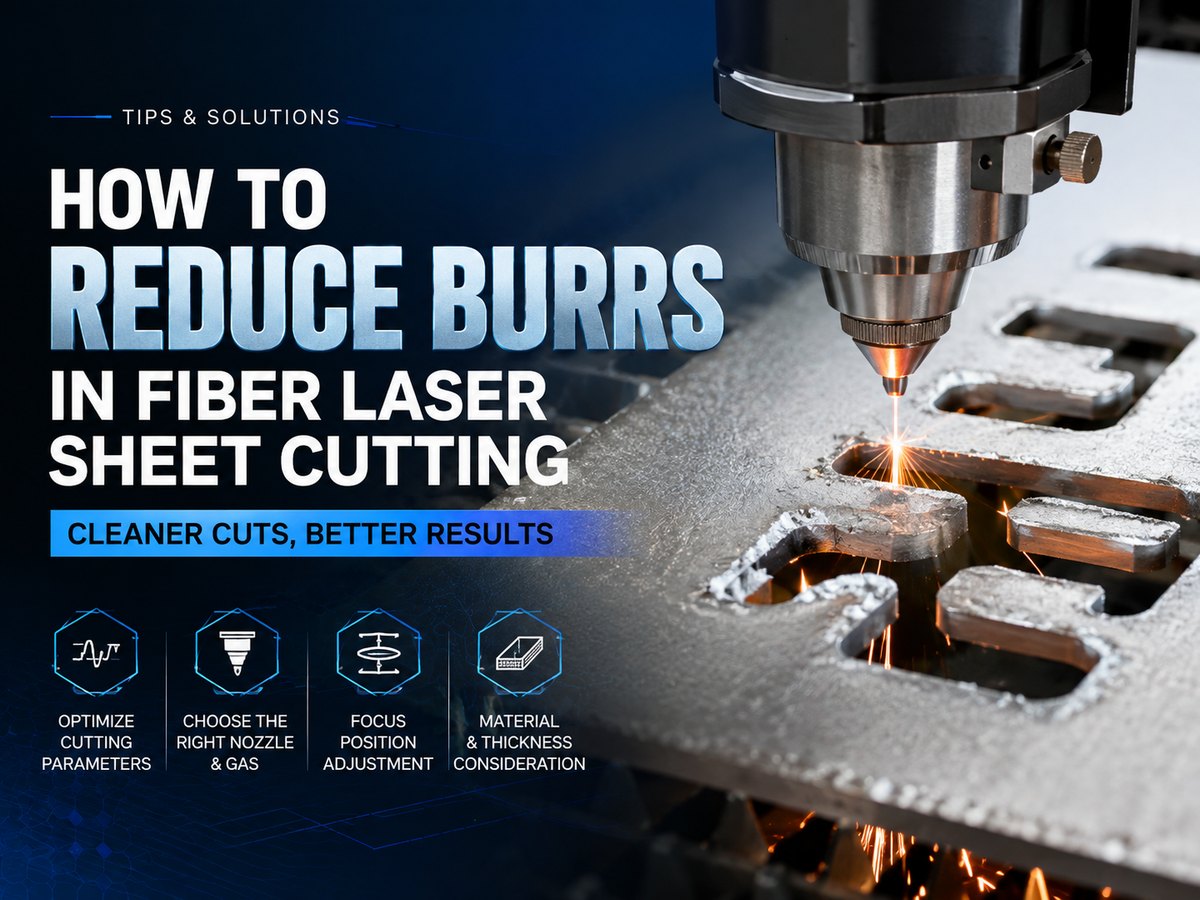
Burrs are among the most common quality problems in fiber laser sheet cutting. Burr formation increases deburring costs, slows downstream production, and can affect welding, coating, assembly, and final product appearance.
A fiber laser cutting machine can normally produce clean edges when the process window is correctly matched to the material. Persistent burrs usually indicate a problem with cutting speed, focal position, assist-gas flow, nozzle condition, beam alignment, material quality, or machine maintenance.
The fastest solution is not to change every parameter at once. Operators should first examine the shape and location of the burr, then adjust one variable at a time.
What Causes Burrs in Fiber Laser Sheet Cutting?
During fiber laser sheet cutting, the laser melts or reacts with material along a narrow kerf. Assist gas pushes the molten metal out through the bottom of the cut.
Burrs form when molten material is not fully removed before cooling. The remaining metal solidifies along the lower edge of the sheet.
Common causes include cutting speed that is too high or too low, incorrect focal position, unstable gas pressure, an unsuitable or damaged nozzle, poor beam centering, incorrect nozzle height, a contaminated protective lens, material variation, and unsuitable piercing or corner parameters.
The visible burr is a symptom. Effective troubleshooting requires identifying which part of the cutting process has become unstable.
Optimize the Cutting Speed and Focal Position
Cutting speed strongly influences edge quality. Excessive speed can leave uncut material or fine, hard burrs because the laser does not provide enough energy per unit length.
A speed that is too low can also create burrs. Excessive heat enlarges the molten zone and may allow liquid metal to adhere to the bottom edge.
Begin with the machine manufacturer's recommended parameters for the material and thickness. Adjust speed in small increments while keeping power, focus, gas pressure, and nozzle configuration unchanged.
Evaluate straight edges, small contours, corners, and piercing transitions separately. A speed that works on a long straight line may require control adjustments for small holes or detailed profiles.
The focal position determines where the laser beam reaches its highest energy density relative to the sheet surface. An incorrect position can change kerf width, cutting-front behavior, penetration, and molten-metal removal.
The best focal position depends on material type, sheet thickness, cutting gas, nozzle, laser power, and cutting strategy. A focus setting suitable for thin stainless steel should not automatically be used for thicker carbon steel or aluminum.
If the machine previously produced clean cuts but burrs suddenly appear, check whether the protective lens is contaminated or damaged. Optical contamination can alter beam quality and shift the effective focus.
Check Assist-Gas Type, Pressure, and Purity
Assist gas removes molten material from the kerf. Insufficient flow allows liquid metal to remain on the lower edge and solidify as burrs.
Gas pressure that is too low may not provide enough force to eject the melt. Excessive pressure can disturb the cutting front, increase gas consumption, and reduce process stability.
The correct gas depends on the material and required edge condition. Oxygen is commonly used for carbon steel cutting, while nitrogen is frequently selected when an oxide-free edge is required on stainless steel, aluminum, and other suitable materials.
Gas purity also affects cutting consistency. Contamination or an unstable supply can change the reaction inside the kerf and produce inconsistent edges.
Check pressure under dynamic cutting conditions rather than relying only on the static supply reading. Regulators, valves, filters, hoses, and the gas supply system can restrict the actual flow reaching the nozzle.
Gas mixtures can reduce burrs in certain material and thickness ranges, but mixed-gas cutting requires a machine and gas system designed for the process. Results depend on material grade, alloy, thickness, laser power, and approved cutting parameters.
Inspect the Nozzle, Centering, and Cutting Height
The cutting nozzle controls how assist gas enters the kerf. Nozzle geometry, diameter, roundness, cleanliness, and alignment directly influence gas flow.
A damaged nozzle may create an uneven gas jet. Molten material may be removed effectively on one side of the cut but remain attached on the opposite side.
Spatter inside the nozzle can restrict flow or change the shape of the gas stream. Even minor nozzle damage can cause burr formation during high-pressure cutting.
Before changing process parameters, remove and inspect the nozzle, check the opening for deformation and spatter, confirm the correct specification, perform a beam-centering test, and verify cutting-height calibration.
Beam centering should be checked after a nozzle collision, cutting-head service, optical replacement, or sudden directional changes in cut quality.
The nozzle-to-sheet gap also affects gas efficiency. If the nozzle is too far away, gas pressure can disperse before reaching the kerf. A nozzle positioned too close increases collision risk and sensitivity to sheet unevenness or tipped parts.
Check height calibration, ceramic condition, sensor connections, and sheet flatness. Slag accumulation on support slats can lift the sheet and change the real cutting height.
Match Parameters to the Material
Two sheets with the same nominal thickness can behave differently because of material grade, alloy composition, surface coating, flatness, and thickness tolerance.
Rust, oil, scale, protective film, and surface contamination can reduce cutting stability. Protective film should only be cut when the film and cutting process have been approved for the machine and material.
Carbon steel quality influences oxygen-cutting reactions. Stainless-steel and aluminum alloys may respond differently to the same nitrogen parameters.
When a validated process suddenly produces burrs after a new material batch is loaded, compare material certificates, actual thickness, surface condition, and flatness before modifying the machine.
Parameter records should identify more than thickness. Record material grade, supplier, surface condition, gas, nozzle, focus, speed, power, and any special corner or piercing settings.
Control Piercing, Corners, and Small Contours
Burrs do not always form evenly along the entire edge. Piercing points, sharp corners, small holes, and closely spaced contours create different thermal conditions from long straight cuts.
An unsuitable pierce can leave excessive molten material near the contour start. Incorrect lead-in placement may pull piercing residue into the finished edge.
Cutting heads slow down around corners and small features. Without suitable power or duty-cycle control, the lower speed can cause heat accumulation and heavy deposits.
Use dedicated small-contour and corner parameters when supported by the control system. Power, speed, gas pressure, and pulse behavior may need to change automatically as the machine enters and exits detailed geometry.
Place lead-ins away from critical surfaces whenever possible. Confirm that the lead-in length and direction allow the cutting process to stabilize before reaching the finished contour.
Clean and Maintain the Optical System
A contaminated protective lens reduces transmitted laser power and can distort energy distribution. Slowing the machine or increasing power cannot permanently correct a dirty optical path.
Inspect the protective window according to the maintenance schedule. Replace contaminated or damaged components using a clean procedure and an appropriate working environment.
The cutting head should remain sealed against dust. Nozzles, ceramic rings, seals, cooling circuits, and gas passages also require routine inspection.
Maintenance should include protective-lens inspection, nozzle cleaning and replacement, beam-centering verification, height-sensor calibration, gas-system leak inspection, cooling-system checks, support-slat cleaning, motion-system inspection, and extraction-system maintenance.
A machine that gradually develops burrs across several materials may have a maintenance problem rather than an incorrect parameter table.
Use a Controlled Troubleshooting Procedure
Changing several settings at the same time makes the real cause difficult to identify. A controlled test saves material and creates reusable process knowledge.
Begin by confirming the correct material and thickness. Inspect the nozzle, protective lens, centering, height control, and gas supply.
Cut a simple test contour using the approved baseline parameters. Record the location, height, hardness, and direction of the burr.
Change only one primary variable, such as cutting speed or focal position. Repeat the test and compare the result with the previous sample.
After straight-line quality improves, verify small holes, corners, sharp transitions, and nested production parts. The final parameter must remain stable across the complete geometry, not only on a test line.
Save the approved settings with clear material and consumable information. Photographs of acceptable and unacceptable edges can help operators recognize future problems more quickly
Conclusion
Reducing burrs in fiber laser sheet cutting requires control of the complete cutting process rather than one isolated parameter.
Begin with burr appearance, then inspect cutting speed, focal position, assist gas, nozzle condition, beam centering, nozzle height, material quality, and optical cleanliness.
Make one adjustment at a time and test the complete part geometry before releasing the parameter for production.
A stable fiber laser sheet cutting process can reduce deburring labor, improve edge consistency, support faster welding and coating, and lower the total cost per finished component.