

Collaborative Welding Robot Solutions for Modern Manufacturing
With the rapid development of industrial automation and intelligent manufacturing, manufacturers are constantly pursuing more efficient, flexible, and safer production operations. Welding is a critical manufacturing process, crucial to product quality and production efficiency. Collaborative welding robots are becoming a new favorite in modern manufacturing, providing companies with efficient, safe, and flexible welding solutions.
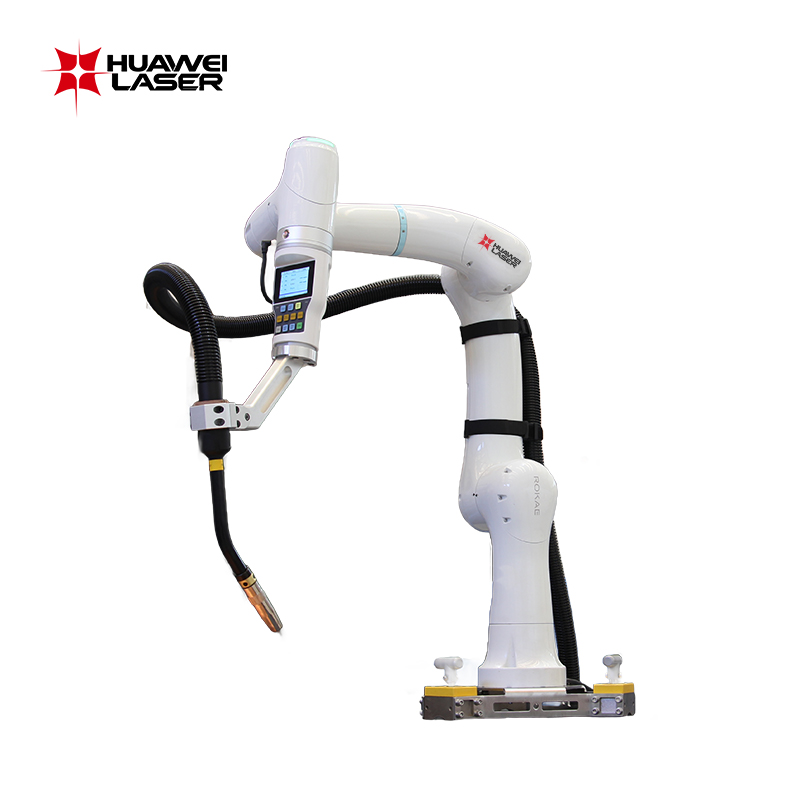
Technical Advantages of Collaborative Welding Robots
1. Safe Collaboration
The HUAWEI LASER collaborative robot features level 5 collision detection, allowing it to work collaboratively without a safety fence, creating a more user-friendly welding environment. Equipped with a magnetic brake, the robot can brake quickly within 18ms in the event of an unexpected power outage, maintaining its position within 1mm (10mm for a striker brake), effectively preventing damage to equipment or products caused by power outages.
2. Stable Performance
The HUAWEI LASER collaborative robot boasts a repeatability of ±0.02mm. Equipped with an anti-shake algorithm, the robot achieves a stop jitter of less than 0.4mm during rapid motion, resulting in superior welding accuracy.
3. Flexible Deployment
The HUAWEI LASER collaborative robot’s lightweight design significantly reduces deployment complexity and costs. Its compact footprint and simple installation allow it to operate in confined environments.
Taking the HUAWEI LASER collaborative robot welding solution as an example, the collaborative robot can be flexibly configured with welding components. Through its proprietary welding process package, the robot can be quickly adapted to various welding machines with simple parameter settings, enabling a variety of welding solutions, including arc welding and laser welding, to meet the needs of enterprises for small-batch, high-variety production.
Application Scenarios
1. Ship Welding
In ship welding, most structural components are stationary and the space is narrow, making welding extremely challenging. collaborative robot welding solution has a small footprint and uses a magnetic base, allowing it to be fixed in any position with a single click. It can be flexibly switched to different workstations, allowing immediate installation and immediate use. Whether welding horizontally or vertically, at right angles or in circular arcs, it can easily perform welding.
2. Aerospace
For challenging materials such as titanium and aluminum alloys, collaborative robots, through precise trajectory control and constant energy input, meet the high-strength and high-reliability welding requirements.
3. Construction Machinery
Collaborative welding robots demonstrate their advantages in thick plate welding and large structural assembly, improving welding efficiency while significantly reducing welding defect rates.
How to Learn Welding from Scratch
Drag-and-Drop Teach Operation: Simple drag-and-drop teach operation allows operators to intuitively understand the machine’s operation and the welding process.
Human-Robot Collaboration: Our collaborative robots are ideally suited for human-robot collaboration, allowing operators to learn welding techniques and master the necessary skills through practical experience.
Real-time Feedback: The system provides real-time operational feedback, enabling operators to correct errors and improve their skills.
Collaborative welding robots offer efficient, safe, and flexible welding solutions for today’s manufacturing industry. Collaborative robots not only significantly improve welding quality and efficiency, but also enhance the working environment for workers, helping companies reduce costs and achieve flexible production.