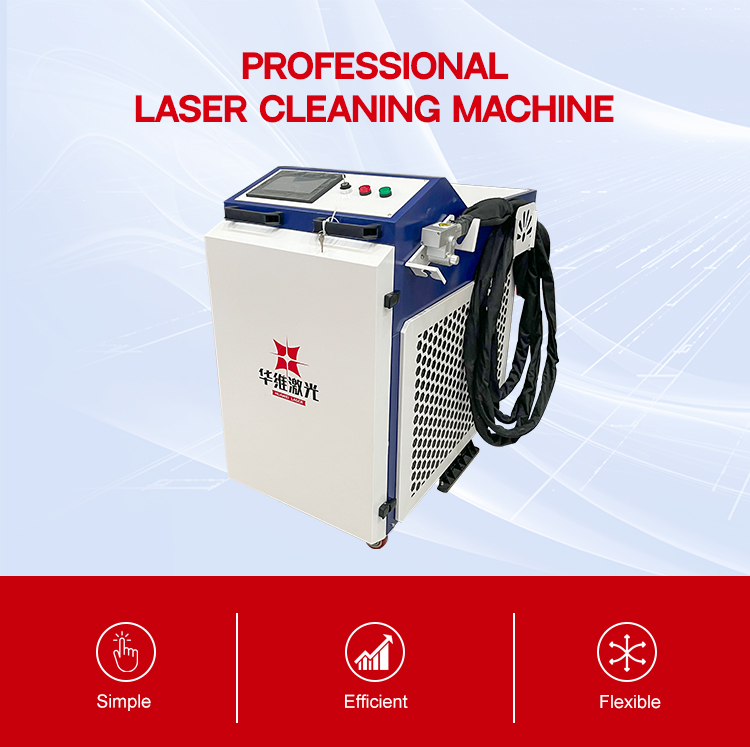

Shipbuilding Applications of Laser Cleaning Machines
In high-end manufacturing fields, including shipbuilding, industrial products such as sheet metal must have surface contaminants such as dirt, grease, dust, and rust removed before painting, welding, and assembly to ensure the quality of the workpiece. To meet the growing cleaning needs of the industry, laser cleaner machine technology has emerged.
Laser Cleaning VS Traditional Cleaning
1. Traditional Ship Cleaning
Previously, pre-production cleaning of ships mainly used sandblasting, but this method has been gradually banned due to the serious dust pollution it causes to the surrounding environment. When using traditional shot blasting for steel plate treatment, with a steel plate travel speed of 0-6 m/min, the surface roughness after treatment is 30-75 μm, and the shot blasting efficiency is ≥100 m²/h.
2. Laser Cleaning
Using laser cleaning to replace the shot blasting process allows for verification of whether the surface quality after laser texturing meets the coating requirements, cleaning efficiency, and production cycle, offering significant advantages. Furthermore, due to its advantages of being environmentally friendly, non-damaging to the substrate, easy to operate, and cost-effective, laser cleaning is gradually replacing traditional cleaning methods in many fields as cleaning technology continues to improve.
Laser Cleaning Technology
Based on the laser emission mode, laser cleaner machine can be divided into two types: continuous laser cleaning and pulsed laser cleaning.
Continuous laser: Provides stable output power, suitable for large-area cleaning, and can quickly remove surface dirt, oxide layers, and light paint layers. For ship bottoms that are constantly immersed in seawater, continuous laser cleaning can be used to clean large areas of rust and paint.
Pulsed laser: Outputs energy in the form of high-peak short pulses, allowing for precise control of energy input, suitable for precision cleaning, thin paint or complex structures, and especially suitable for localized paint removal and micro-structure surface treatment.
In the shipbuilding field, both laser methods have their advantages and can be flexibly selected according to specific cleaning needs.
Application of Laser Cleaning in Ship Rust Removal
Ship steel is prone to rust during long-term use, especially the bottom, bilge, and side parts of the hull in a seawater environment. Traditional rust removal methods often use manual grinding, sandblasting, or chemical rust removers. These methods have problems such as high labor intensity, low efficiency, and serious environmental pollution. The emergence of laser cleaner machine technology provides an efficient and environmentally friendly solution for ship rust removal:
1. Fast rust removal
Laser cleaning can remove rust layers without damaging the base material. Continuous lasers are suitable for large areas of rust, and the cleaning speed can be several times faster than traditional methods.
2. Precise local treatment
Pulsed laser cleaner machine can accurately remove rust from welds, corners, and complex geometric structures, avoiding damage to surrounding metal surfaces.
3. Environmentally friendly and waste-free
Compared with sandblasting, laser cleaning does not produce a large amount of dust and does not require the use of chemical reagents, reducing environmental pollution and lowering operational risks.
Therefore, laser rust removal has become an important technical means in shipbuilding, maintenance, and second-hand ship refurbishment.
Application of Laser Cleaning in Ship Paint Removal
Paint removal is one of the most critical surface treatment steps in the shipbuilding process. The paint layer on a ship is not only used for corrosion protection, antifouling, and aesthetics, but also affects the long-term service life of the hull. Traditional paint removal methods include manual grinding, sandblasting, and chemical stripping, which have the following problems:
1. Low efficiency
Manual grinding is time-consuming and labor-intensive, and it is difficult to handle complex structures.
2. Serious environmental pollution
Sandblasting and chemical stripping produce a large amount of dust and harmful waste liquid.
3. High safety risks
Chemical stripping may produce toxic gases, posing a significant hazard to operators.
In the shipbuilding industry, especially for hull maintenance or refurbishment of old ships, laser cleaner machine technology can quickly strip off old paint layers, providing a clean and uniform metal surface for subsequent painting, greatly improving coating adhesion and hull corrosion resistance.
Laser cleaning machines, through their non-contact, non-destructive, efficient, environmentally friendly, and precisely controllable technical characteristics, solve the problems of low efficiency, high pollution, and damage to the base material associated with traditional methods in ship rust removal. It also complies with green shipping trends and environmental regulations. With the development of laser technology, automation, and intelligence, laser cleaning will play a greater role in ship rust removal, driving the shipbuilding industry towards a more efficient, green, and intelligent future. Huawei Laser has launched a new high-power, portable continuous laser cleaning machine, featuring high average power (1500–3000 W), high energy output, and ease of use and maintenance.