

Why Tube Laser Cutting Is Replacing Traditional Pipe Processing in Modern Manufacturing?
Traditional pipe processing has long served as the foundation of metal fabrication, yet the limitations of traditional pipe processing are becoming increasingly evident in today’s competitive market. Rising demands for extreme precision and production flexibility are accelerating a global shift toward the Tube Laser cutting machine. This transition represents a fundamental change in how industries handle tubular components.
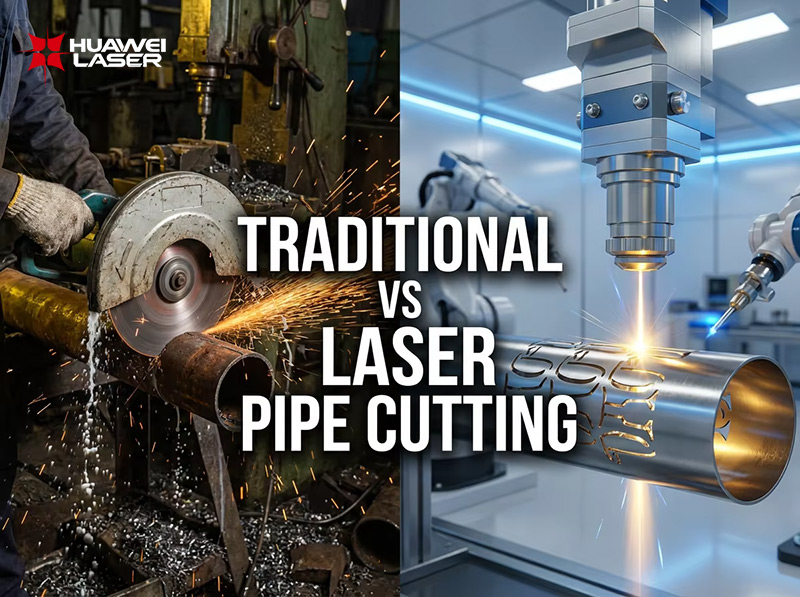
Understanding Traditional Pipe Processing
Traditional pipe processing encompasses various mechanical and thermal methods used before the rise of fiber laser technology. This conventional workflow typically involves a multi-machine setup. Manufacturers must use separate equipment for saw cutting, drilling operations, milling, and punching. Because these mechanical methods rely on physical contact, the mechanical tools often leave burrs or imperfections on the metal surface.
The Innovation of the Tube Laser cutting machine
As a advanced thermal process, the Tube Laser cutting machine concentrates a high-power laser beam to melt material instantly. High-pressure assist gases then blow the molten metal away to form a perfect kerf. By utilizing sophisticated laser software, the Tube Laser cutting machine transforms digital CAD designs into finished parts directly from raw stock. This automated workflow handles loading, nesting, and cutting in one continuous motion.
Superior Automation and Reduced Labor
Traditional pipe processing requires skilled operators to manually clamp tubes, change heavy tools, and transfer workpieces between different stations. Such manual dependency often leads to inconsistent quality and higher labor expenses. Conversely, the Tube Laser cutting machine integrates positioning and unloading into a highly autonomous system. Operators simply select the program, and the Tube Laser cutting machine executes the task with minimal human intervention.
Unmatched Design Flexibility
Modern industrial designs often require complex shapes and intricate joints that traditional tools cannot easily reach. Traditional methods require changing physical blades or dies whenever the tube wall thickness varies. The Tube Laser cutting machine eliminates these physical constraints by adjusting laser power and focal position via software. Whether processing round, square, or special-profile tubes, the Tube Laser cutting machine provides unlimited geometric freedom.
Production Adaptability for Custom Orders
Manufacturing trends are shifting from high-volume production to customized, small-batch orders. Traditional tube processing struggles with frequent changeovers due to long setup times for new fixtures. The Tube Laser cutting machine addresses this challenge through software-driven adjustments. This digital flexibility allows the Tube Laser cutting machine to handle diverse dimensions and geometries without expensive mechanical downtime.
Higher Efficiency and Lower Overall Costs
Global competition forces manufacturers to control costs and shorten delivery deadlines. Traditional workflows involve repeated material handling and secondary deburring, which adds to the total production time. A single pass through the Tube Laser cutting machine completes all required features, significantly reducing intermediate handling. By optimizing material utilization through nesting, the Tube Laser cutting machine further reduces waste and operational overhead.
Precision and Superior Edge Quality
Cumulative errors often occur in traditional processing when parts move between multiple machines. The Tube Laser cutting machine maintains incredible dimensional consistency because all operations happen within a single CNC-controlled environment. The clean edges produced by the Tube Laser cutting machine generally require no secondary grinding. Consequently, these finished parts are ready for immediate downstream assembly or high-quality welding.
Upgrade Your Production Line
For manufacturers seeking to stay ahead in modern manufacturing, investing in a high-performance Tube Laser cutting machine is the most effective way to enhance factory throughput and product quality. Exploring modern Industrial Tube Laser Solutions can provide the competitive edge needed in today's precision-driven market.