

What Is Heat Affected Zone (HAZ) in Laser Welding?
When evaluating laser welding quality, many people focus on weld penetration, weld appearance, strength, and spatter. However, there is another area that deserves attention: the Heat Affected Zone (HAZ).
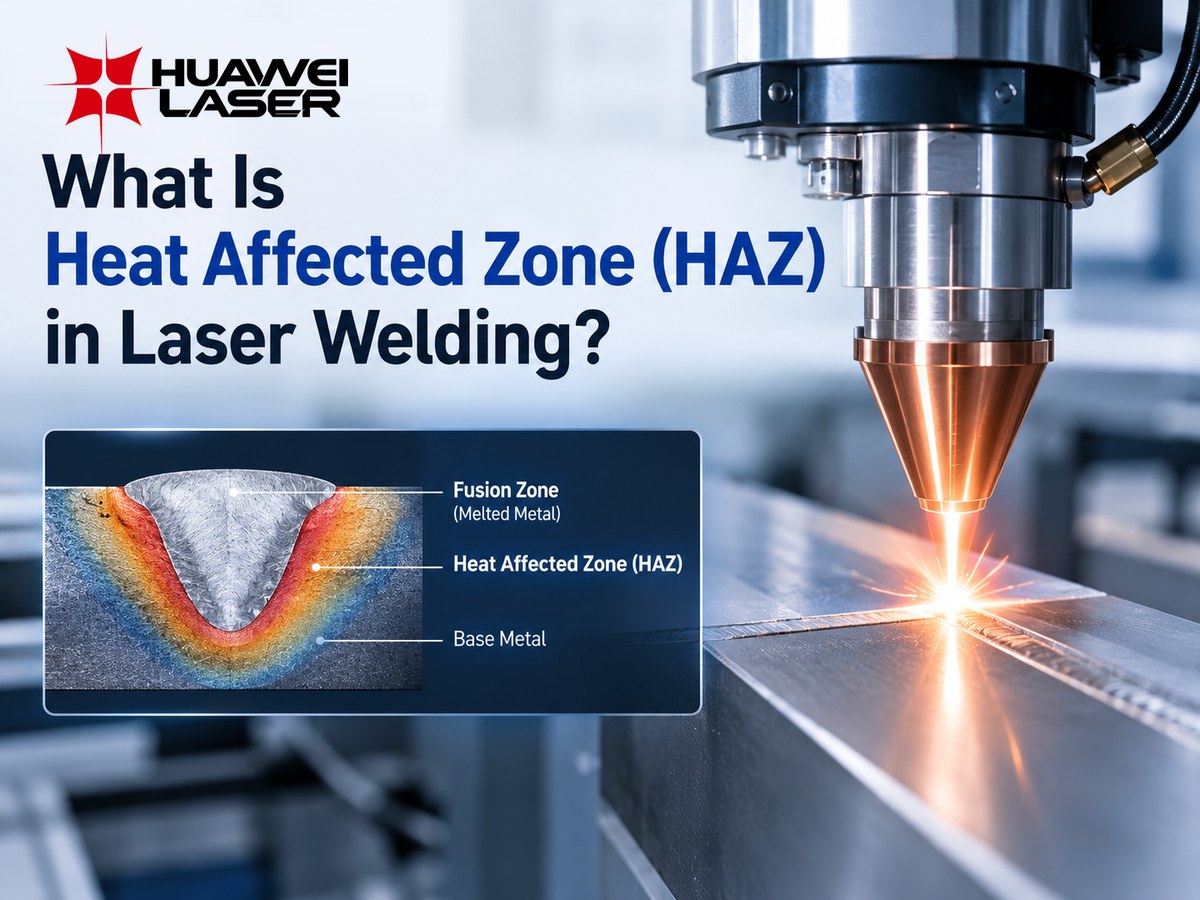
The HAZ is not the molten weld itself. It is the region of the base material surrounding the weld that does not melt but is exposed to enough heat to experience changes in its microstructure or properties.
So, does laser welding produce a heat affected zone?
Yes. Laser welding cannot completely eliminate the HAZ because heat inevitably conducts away from the weld pool. However, the highly concentrated energy of a laser can limit the amount of surrounding material exposed to high temperatures. Under suitable process conditions, laser welding can therefore produce a relatively narrow HAZ compared with many conventional welding processes.
Understanding the HAZ is important because a smaller HAZ is not automatically the only goal. The real objective is to control heat input so that the weld achieves the required penetration and mechanical performance without unnecessarily altering the surrounding material.
What Is the Heat Affected Zone?
During laser welding, the laser beam delivers concentrated energy to the joint. The material directly exposed to sufficient energy melts and forms the fusion zone.
Around this molten area is another region that becomes hot but does not reach its melting point. This is the Heat Affected Zone, or HAZ.
The HAZ can be divided conceptually into different thermal regions depending on the material. Some areas may experience temperatures high enough to cause grain growth or phase transformation, while areas farther from the weld may experience only limited thermal changes.
The important point is that the HAZ is defined by thermal exposure and resulting material changes, not simply by visible discoloration around the weld.
This distinction matters when evaluating laser welding quality.
Why Does HAZ Form During Laser Welding?
Heat always moves from a high-temperature area toward cooler surrounding material.
During welding, the laser creates a localized high-temperature region. Part of the energy is consumed in melting the material and forming the weld pool, while heat also conducts into the surrounding base metal.
The material immediately next to the fusion zone can therefore experience a rapid heating and cooling cycle.
Even though the laser beam is highly concentrated, the surrounding material is still affected by this thermal cycle.
The size and characteristics of the HAZ depend on factors such as:
- Laser power
- Welding speed
- Beam diameter
- Focus position
- Material thickness
- Thermal conductivity
- Joint configuration
- Shielding gas
- Welding model
- Initial material temperature
- Heat dissipation conditions
This is why there is no universal HAZ width that applies to every laser welding application.
Does Laser Welding Have a Smaller HAZ?
Generally, laser welding can produce a relatively narrow HAZ because the laser delivers energy at high power density to a localized area.
The combination of concentrated energy, controlled beam size, and potentially high travel speed can reduce the amount of heat transferred into the surrounding material.
However, it would be inaccurate to say that laser welding produces “no HAZ.”
Laser welding still involves a thermal cycle. The important difference is that the process can be designed to keep unnecessary heat away from the surrounding material.
Research on fiber laser welding has also demonstrated that heat input can significantly influence HAZ width and hardness. For example, one study on 22MnB5 steel found that increasing heat input from 12.5 to 62.5 J/mm increased the width of the softened HAZ from approximately 0.2 mm to 2.2 mm under the tested conditions.
This illustrates an important principle:
HAZ control is fundamentally a heat-input control problem.
Heat Input: The Key Factor Behind HAZ
Heat input is one of the most useful concepts for understanding HAZ.
In a simplified view, increasing laser power increases the energy supplied to the workpiece, while increasing welding speed reduces the time that a specific section of material is exposed to the laser.
A commonly used engineering approximation for linear heat input is:
Heat Input ≈ Laser Power / Welding Speed
The actual thermal behavior is more complicated because laser absorption, efficiency, beam characteristics, material properties, and heat losses also play important roles.
Nevertheless, the relationship provides a useful way to understand why simply increasing laser power is not always the best way to improve penetration.
For example, if laser power is increased significantly while welding speed remains unchanged, more energy enters the material. This may improve penetration, but it can also increase thermal exposure and widen the HAZ.
Conversely, increasing welding speed can reduce heat input, but if the speed becomes too high, penetration may become insufficient.
The goal is therefore not minimum heat at any cost. The goal is the appropriate amount of heat for the required weld.
How Does HAZ Affect Material Properties?
The most important characteristic of HAZ is that its effects are not always visible.
A weld may look clean on the surface while the material near the weld has undergone microstructural changes.
Depending on the material and thermal cycle, the HAZ may experience:
Grain Growth
When certain metals remain at elevated temperatures for sufficient time, their grains can grow.
Grain growth may affect mechanical properties and can be especially important when welding heat-sensitive materials.
Hardening or Softening
Some steels can experience significant changes in hardness after welding.
For example, particular thermal cycles can produce hard or brittle microstructures, while other conditions can cause localized softening.
The effect depends strongly on the material grade and its original heat-treatment condition.
Phase Transformation
Some alloys undergo changes in crystal structure when heated and cooled.
The resulting phase transformation can affect hardness, toughness, strength, and other mechanical properties.
Residual Stress and Distortion
Uneven heating and cooling can produce thermal stresses.
If these stresses are sufficiently large, the component may experience distortion or dimensional changes.
For precision parts and thin sheet applications, controlling thermal distortion can therefore be just as important as achieving sufficient weld penetration.
What Is Heat Tint and Is It the Same as HAZ?
A common visual sign around some laser welds is heat tint, especially when welding stainless steel or titanium.
Heat tint refers to visible surface discoloration caused by oxidation at elevated temperatures. Depending on the material and conditions, the surface may appear yellow, brown, blue, purple, or other colors.
However, heat tint and HAZ are not the same thing.
Heat tint is a visible surface phenomenon, while HAZ describes a region of material that has experienced a thermal cycle and may have undergone microstructural or property changes.
This means that using discoloration alone to determine the exact HAZ is not always reliable.
Surface condition, oxygen concentration, shielding effectiveness, material composition, and other factors can influence the appearance of heat tint.
For applications where corrosion resistance or appearance is important, controlling shielding gas and post-weld cleaning may be particularly important.
How Can You Evaluate the HAZ?
The appropriate evaluation method depends on the application and quality requirements.
1. Visual Inspection
Visual inspection is the simplest method.
Operators can check for:
- Discoloration
- Excessive oxidation
- Distortion
- Uneven weld appearance
- Visible cracks
- Excessive spatter
However, visual inspection cannot reveal every change inside the material.
2. Microhardness Testing
Microhardness measurements can help identify changes in hardness across the weld, HAZ, and base material.
This can be useful when evaluating whether a welding process has caused localized hardening or softening.
3. Metallographic Analysis
For engineering development or failure analysis, a cross-section of the weld can be prepared and examined under a microscope.
This can reveal the fusion zone, HAZ, grain structure, and other microstructural characteristics.
4. Mechanical Testing
Depending on the application, tensile, bending, impact, or other mechanical tests may be used to evaluate the overall performance of the welded joint.
This is particularly important when welding components that must meet specific mechanical requirements.
What Factors Control the HAZ in Laser Welding?
There is no single parameter that determines HAZ. Instead, several parameters work together.
Laser Power
Higher power increases the energy delivered to the workpiece.
If the power is too low, penetration may be insufficient. If it is unnecessarily high, thermal exposure may increase.
The correct power should therefore be selected based on material, thickness, joint configuration, and required penetration.
Welding Speed
Welding speed determines how long the laser interacts with a particular section of material.
A slower speed generally increases heat input per unit length, while an excessively high speed can result in insufficient penetration.
The appropriate speed should therefore be considered together with laser power.
Focus Position
The focus position affects the energy density and shape of the laser beam at the workpiece.
A properly selected focus can help concentrate energy where it is needed and produce a stable weld profile.
An unsuitable focus position can change penetration, weld width, and heat distribution.
Beam Size
A smaller beam spot generally provides higher energy density, while a larger spot distributes the energy over a wider area.
The appropriate beam size depends on the material and the desired weld geometry.
Welding Mode
Continuous-wave and pulsed laser welding produce different thermal cycles.
Continuous-wave laser welding provides continuous energy and is commonly used where stable penetration and higher production speeds are required.
Pulsed laser welding delivers energy in discrete pulses and can be useful for applications requiring controlled energy input, particularly for thin or heat-sensitive components.
The choice should be based on the material, thickness, joint design, and production requirements rather than assuming that one mode is universally better.
How to Reduce Unnecessary HAZ and Improve Welding Quality
If the objective is to control HAZ while maintaining the required weld penetration, several practical measures can help.
1. Optimize Power and Speed Together
Do not adjust laser power independently.
Power and welding speed should be evaluated together because both influence heat input and weld penetration.
2. Use the Correct Focus Position
A stable and properly positioned laser focus helps maintain consistent energy density at the joint.
3. Maintain Accurate Joint Fit-Up
An excessive or inconsistent gap can change the amount of material that needs to be melted and may require additional energy.
Accurate part positioning and consistent joint conditions can therefore improve process stability.
4. Keep the Workpiece Clean
Oil, rust, moisture, paint, and other contaminants can affect laser absorption, shielding conditions, and weld stability.
Proper surface preparation is especially important when consistent welding quality is required.
5. Optimize Shielding Gas
Shielding gas protects the molten pool from atmospheric contamination.
The gas type, flow rate, nozzle position, and coverage should be selected according to the material and application.
Poor shielding can cause oxidation and heat tint and may negatively affect weld appearance and performance.
6. Conduct Sample Testing Before Production
A parameter that works on one material thickness or joint configuration may not work on another.
Before production, test samples should be welded and evaluated for:
Penetration
Weld width
HAZ characteristics
Surface appearance
Spatter
Distortion
Mechanical performance when required
This approach is more reliable than choosing parameters based only on laser power.
HAZ Control Does Not Mean “The Smaller, the Better”
One important point is often overlooked.
A narrow HAZ is generally desirable when it helps reduce unnecessary thermal effects, but the smallest possible HAZ is not automatically the best welding condition.
If the heat input is reduced too aggressively, the weld may suffer from:
Insufficient penetration
Lack of fusion
Unstable weld formation
Poor joint strength
In some materials, reducing heat input can even increase specific cracking risks under certain conditions. Research on Haynes 282 nickel-based superalloy, for example, found that HAZ cracking behavior was related not simply to heat input magnitude, but to the thermal exposure and resulting material behavior.
Therefore, the objective should be:
Sufficient heat for reliable fusion, but no unnecessary heat beyond what the application requires.
Conclusion
The Heat Affected Zone (HAZ) is a natural part of laser welding. It forms because heat from the molten weld area conducts into the surrounding material.
Compared with many conventional welding processes, laser welding can provide a relatively concentrated heat source and therefore help limit the width of the HAZ. However, the actual result depends on laser power, welding speed, focus position, beam characteristics, material properties, joint design, shielding conditions, and other process variables.
The key to controlling HAZ is not simply reducing heat as much as possible.
It is about finding the right thermal balance:
enough energy to achieve reliable penetration and fusion, while limiting unnecessary heat exposure to the surrounding material.
For manufacturers and welding operators, developing parameters for the specific material and application, validating them through sample testing, and maintaining stable process conditions are essential steps toward consistent laser welding quality.