

How to Reduce Piercing Spatter in Laser Cutting
Piercing is the first critical stage of most closed-contour laser cutting operations. Before a laser cutting machine follows the programmed contour, the laser beam must penetrate the sheet and create a stable path for molten material to escape.
Poorly controlled piercing can produce excessive spatter, large craters, damaged surfaces, contaminated protective lenses, unstable cuts, and additional cleaning work. Severe piercing spatter may also adhere to the nozzle or cutting head and reduce production reliability.
Reducing piercing spatter requires more than lowering laser power. Effective control depends on coordinating laser energy, pulse timing, focus position, assist gas, nozzle condition, stand-off distance, material quality, and cutting program design.
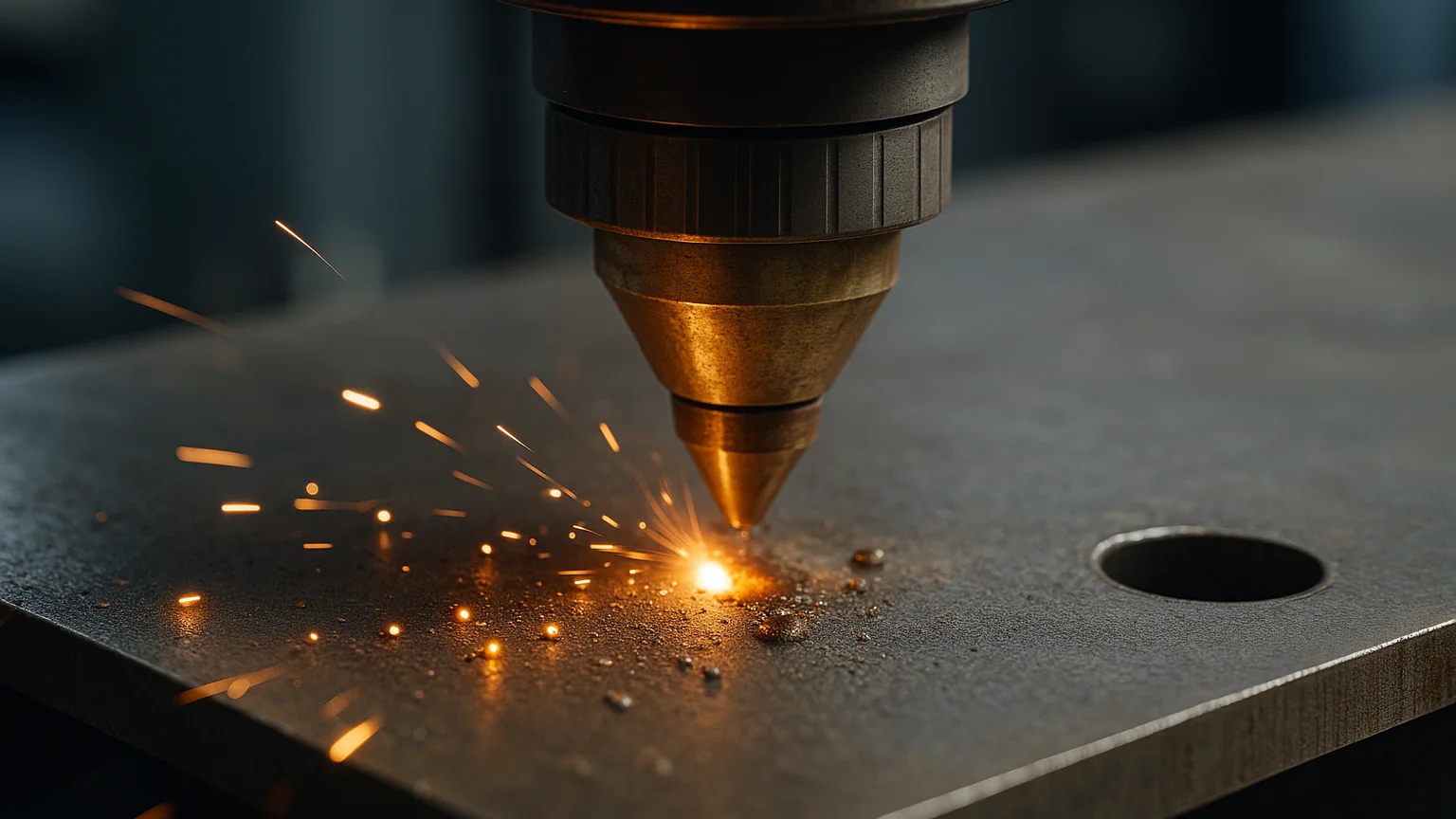
Why Does Piercing Produce Spatter?
During piercing, concentrated laser energy rapidly heats, melts, and partially vaporizes the metal. Vapor pressure and assist gas force the molten material out of the developing hole.
At the beginning of the process, the laser beam has not yet created a complete channel through the sheet. Some molten metal therefore escapes upward instead of leaving through the bottom of the material. The upward-moving droplets form piercing spatter around the hole.
A certain amount of spatter may be normal, especially when processing thicker plate. Excessive spatter usually indicates that the piercing process is delivering energy too aggressively, removing molten material inefficiently, or continuing after penetration has been completed.
Match the Piercing Strategy to the Material
A fiber laser cutting machine may provide rapid, pulse, or multi-stage piercing modes. The available modes depend on the controller, laser source, cutting head, material, and sheet thickness.
Rapid piercing is generally suitable for thinner materials when penetration can be achieved without excessive heat accumulation. Applying an aggressive rapid-piercing strategy to thicker plate can create a large crater and eject significant amounts of molten metal.
Pulse piercing introduces energy in controlled pulses. The intervals between pulses allow molten material to leave the hole and can reduce continuous heat accumulation. Pulse frequency, duty cycle, peak power, and piercing duration must work together.
Multi-stage piercing divides the process into controlled phases. A fiber laser cutting machine may begin with lower energy, adjust focus or gas conditions as the hole develops, and complete penetration before entering the cutting contour.
Optimize Laser Power and Piercing Time
Excessive piercing power can melt more material than the gas flow can remove. Molten metal then accumulates inside the hole and is expelled upward as large droplets.
Insufficient power can also create problems. A laser cutting machine that fails to complete penetration within the programmed time may continue heating the upper surface, producing a wider crater without establishing a clean opening.
Piercing time should be long enough to achieve full penetration but not substantially longer. Continuing to apply energy after penetration can enlarge the hole, increase the heat-affected area, and generate additional spatter.
Parameter optimization should begin with the recommended cutting database for the actual material and thickness. Operators should adjust one variable at a time and record the results.
Check Focus Position and Stand-Off Distance
Focus position influences the energy density inside the developing piercing hole. An incorrect focal position can concentrate too much energy on the upper surface or prevent sufficient energy from reaching deeper into the material.
The correct piercing focus may differ from the focus position used for contour cutting. Some laser cutting machine controllers allow separate focus settings for piercing and cutting.
Nozzle-to-sheet distance also affects gas flow and molten-material removal. A distance that is too small can expose the nozzle to heavy spatter, while a distance that is too large may reduce assist-gas effectiveness.
Operators should verify capacitive height sensing, nozzle calibration, sheet flatness, and ceramic-component condition before changing process parameters. A height-control problem cannot be reliably corrected by adjusting laser power alone.
Inspect the Nozzle, Beam Centering, and Optics
The nozzle directs assist gas into the piercing hole. Nozzle shape, diameter, cleanliness, and alignment all influence gas flow. A damaged or partially blocked nozzle can create an asymmetric gas stream and irregular spatter.
Beam centering should be checked regularly. When the laser beam is not centered within the nozzle opening, the nozzle may heat unevenly and the cutting gas cannot act symmetrically around the beam.
Operators should inspect the nozzle after a collision or whenever piercing quality changes suddenly. The protective lens should also be checked according to the maintenance procedure because contamination can scatter the beam, alter the focal condition, and reduce cutting quality.
Control Assist Gas Without Creating Turbulence
Assist gas helps remove molten material from the piercing hole. Gas type and pressure depend on the material, thickness, cutting method, and required edge quality.
Gas pressure that is too low may fail to remove molten metal efficiently. Excessive gas pressure is not an automatic solution because an unsuitable pressure or nozzle configuration can disturb the molten pool and spread hot droplets across a larger area.
Gas purity and delivery stability also matter. Leaks, blocked filters, contaminated lines, damaged regulators, or inconsistent supply pressure can make piercing performance change during production.
The best gas setting should be validated together with nozzle diameter, stand-off distance, focus position, and laser power.
Improve the Cutting Program and Pierce-Point Location
Piercing should normally begin on a lead-in path rather than directly on the finished edge. A properly designed lead-in keeps the piercing crater and most surface residue away from the required contour.
The lead-in must provide enough distance for the process to stabilize before the cutting head reaches the finished geometry. Piercing points should also be positioned away from narrow bridges, sensitive corners, small features, and areas where heat accumulation could affect dimensional accuracy.
For parts containing many holes, pre-piercing can be considered. The laser cutting machine completes piercing points first and then returns to cut the contours. The program should balance cooling time, path length, and reliable contour entry.
Keep Material Conditions Consistent
Rust, scale, oil, paint, moisture, protective film, and heavy surface contamination can change how laser energy is absorbed. Material variation can make a previously stable piercing program produce inconsistent spatter.
The sheet should be flat and properly supported. A warped plate changes the distance between the nozzle and material surface, which affects gas flow and focal position.
When piercing quality varies across the same sheet, operators should inspect surface condition, plate flatness, nozzle height, gas supply, and optical cleanliness before making major parameter changes.
Diagnose Piercing Spatter Systematically
A large crater with heavy droplets may indicate excessive energy, long piercing time, poor focus, or insufficient removal of molten material. Spatter concentrated on one side may suggest an off-center beam, damaged nozzle, angled gas flow, or uneven material position.
Repeated nozzle contamination may indicate that the stand-off distance is too small, the piercing method is too aggressive, or the cutting head remains above the piercing point for too long.
Operators should avoid changing several parameters simultaneously. A controlled test using the same material, thickness, nozzle, and gas conditions makes the real cause easier to identify.
Validate the Process Before Production
Piercing parameters should be tested on material from the same production batch whenever possible. Operators should evaluate entrance-hole diameter, crater size, spatter radius, penetration time, nozzle contamination, and the transition into the cut.
Successful settings should be stored by material grade, thickness, nozzle type, assist gas, focus position, and cutting-head configuration. A documented process database helps different shifts reproduce the same results.
Regular nozzle inspection, beam-centering checks, height calibration, gas-system maintenance, and protective-lens monitoring should form part of preventive maintenance.
Conclusion
Piercing spatter cannot be controlled through a single setting. A stable result comes from matching the piercing method to the material, delivering only the required laser energy, maintaining effective gas flow, setting the correct focus and nozzle height, and placing pierce points away from finished contours.
A properly maintained fiber laser cutting machine should produce repeatable piercing results without excessive craters, heavy surface residue, or frequent cutting-head contamination. Controlled testing and documented parameter records can reduce rework, protect optical components, and improve production efficiency.
Improve Piercing Quality with the Right Laser Cutting Solution
For manufacturers evaluating a fiber laser cutting machine, Huawei Laser can provide machine selection guidance, sample-cutting evaluation, parameter-development support, operator training, and after-sales service. Contact Huawei Laser to discuss material types, sheet thicknesses, part drawings, and production requirements.