

Common Types and Applications of Laser Welding Joints
In the laser welding process, the form of the welding joint determines how the parts are assembled together. They may overlap or butt against each other, which directly affects the welding quality, structural strength and product performance. This article will introduce four common types of laser welding joints, their characteristics and applications in detail to help readers better understand the practical application value of laser welding technology.
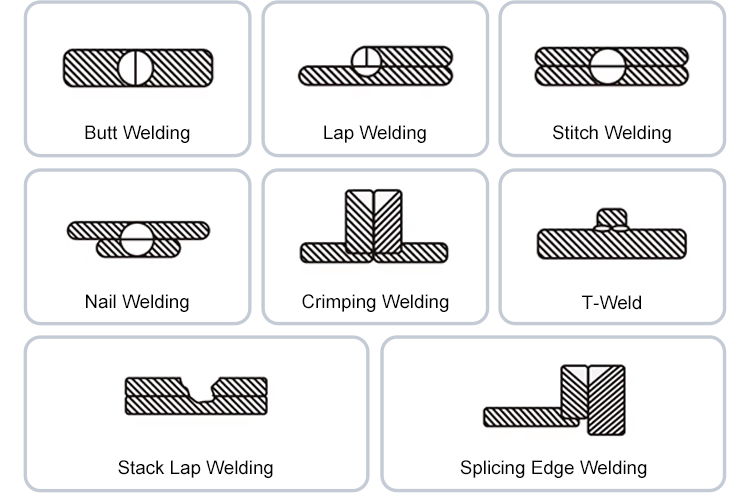
Butt joint
1. Principle
Butt joints are joints in which the edges of two steel plates are arranged relative to each other, and the laser beam is used to weld along the seam direction and make the surfaces in a straight line.
2. Characteristics
The axial load transmission efficiency of butt joints exceeds 90%, and the stress distribution of the weld is symmetrical. It can withstand large static and vibration loads, so it is the most commonly used joint form in welding structures. At the same time, pay attention to ensure the butt gap accuracy of 0.1 mm and use a double-sided protective gas device.
3. Application
Butt joints are widely used in the longitudinal seams of pressure vessel cylinders, the splicing of aluminum alloy bodies for rail transit, etc. For example, the splicing of steel plates in car doors, roofs, chassis, etc.
T-joint
1. Principle
The two components of the T-joint are perpendicular to each other or inclined at a certain angle, and the laser beam is used to weld along the boundary line to form a welded joint.
2. Features
T-joint welding is difficult, and the whole joint has poor load bearing capacity, especially vibration load. However, due to the complexity and diversity of structural components, this type of joint is also one of the more common forms in welded structures.
3. Application
T-joints are often used to connect flat materials. For example, the reinforcement of mechanical equipment, the skeleton structure of rail transit vehicles, the node connection of building steel structures, etc. can all be welded using the laser T-joint welding process.
Corner joint
1. Principle
An corner joint is a joint in which two steel plates are arranged at right angles or a certain corner and welded on the top edge of the plate. Corner joints can be used for corner connections between plates, between pipes and plates, and between pipes and pipes.
2. Features
Compared with butt joints, it saves 15%-20% of the parent material and has a higher tolerance for assembly tolerance. Note that the laser beam inclination is controlled at 75°-80°, and special fixtures are required to prevent deformation.
3. Applications
Corner joints are widely used in the manufacture of pipeline flange connections, chassis sheet metal components, steel structure node reinforcement, household appliance housings, etc. For example, they are widely used in aerospace, electronics, chemical and other industries.
Lap joints
1. Principles
A lap joint is a joint in which two steel plates are overlapped, and the edges of the overlapped ends are welded by plug welding or slot welding. A plug weld refers to a weld formed by welding two plates in a circular hole when two plates overlap, one of which has a circular hole; a slot weld refers to a weld formed by welding two plates in a long hole when two plates overlap, one of which has a long hole.
2. Features
The lap joint has relatively low assembly accuracy requirements for the workpiece, is insensitive to assembly clearance, and has strong adaptability. It can achieve welding of dissimilar materials.
3. Applications
Lap joints are widely used in industries such as automobile manufacturing, electronic products, and household appliances. For example, the door sills, reinforcement ribs, seat frames and other parts of the automobile body often use laser lap welding technology to achieve efficient connection of multi-layer steel plates.
Laser Welding Joints Types
There are many types of laser welding joints. In addition to the four common forms mentioned above, there are also some special types of joints, such as plug joints, single-flanged edge joints, edge joints, knife edge joints, etc. These types of laser welding joints play an important role in different industrial applications. They can meet various complex connection requirements and improve the overall performance and reliability of the welded structure.
How to choose the form of laser welding joints?
The principle of selecting the form of welding joint is to ensure the quality of welding joint and minimize the use of filler metal.
1. Select according to material properties
Different materials (such as steel, aluminum, copper, etc.) have different adaptability to welding heat input, metallurgical reactions, and joint forms. For example, aluminum alloys usually use lap joints, while high-strength steels are suitable for butt joints.
2. Consider the applicability of joint forms
Butt joints: Suitable for welding that requires high strength, the weld is close to the parent material performance, and is suitable for welding thin plates and medium and thick plates.
Lap Joint: Suitable for connecting materials of different thicknesses, can tolerate large assembly gaps, is convenient for multi-layer welding, and is often used for welding dissimilar materials.
Corner Joint: Suitable for box and frame structures, easy to weld, but has high requirements for welding technology.
T-joint: Suitable for strengthening and supporting structural parts, can effectively improve rigidity, and is suitable for bearing bending and torsion loads.
Summary
When selecting laser welding joints, you can refer to their structural principles, characteristics and application advantages for comprehensive consideration. Reasonable selection of welding joints can improve the structural strength and service life of the product and reduce manufacturing costs.