

Advantages of Laser Welding for Stainless Steel Components
Welding technology plays a vital role in the connection process of stainless steel parts. In recent years, laser welding technology has gradually replaced traditional TIG, MIG and other welding processes with its advantages of high efficiency, precision and high degree of automation, and has become the first choice for stainless steel parts processing. This article will discuss in detail the main advantages of laser welding for stainless steel processing and analyze its performance in practical applications.
Advantages of laser welding for stainless steel
Laser welding of stainless steel has many significant advantages, such as high welding strength and good heat treatment resistance, making it the first choice for various applications. Let’s explore these advantages in detail.
1. Excellent welding quality and excellent deformation control
A major advantage of laser welding is that it can achieve high-quality welding while keeping the deformation of the workpiece to a very low level. This is due to the extremely high energy density of the laser beam, which can quickly heat and cool in a local area, thereby significantly reducing heat input.
Compared with the warping and thermal deformation easily caused by traditional welding methods, laser welding can accurately control the heat-affected zone during welding, effectively maintain the structural integrity and dimensional accuracy of the welded joint, and is especially suitable for stainless steel components with high requirements for appearance and flatness.
2. Non-contact welding to avoid component damage and contamination
Another significant advantage of laser welding is its non-contact processing characteristics, which completely eliminates the physical contact between the tool and the metal surface.
Unlike traditional welding processes, the latter usually require electrodes or filler materials to be in direct contact with the workpiece, which can easily cause mechanical damage to sensitive parts or introduce impurity contamination. Laser welding melts the material through a high-energy focused laser beam to achieve a non-contact, high-precision welding process. This method not only protects the surface of the material, but also greatly improves the cleanliness and reliability. It is particularly suitable for precision components and high cleanliness requirements. Application scenarios, such as electronics, medical, aerospace and other fields.
3. High degree of automation, suitable for mass production
The laser welding system can be easily integrated into robots, automated production lines or CNC equipment, and accurate welding of any path can be achieved through programming. Combined with the visual positioning system, high-precision positioning and automatic deviation correction of stainless steel parts can also be achieved.
In the mass production of stainless steel products, laser welding for stainless steel not only improves consistency and repeatability, but also greatly reduces the reliance on manual skills and improves overall production capacity.
4. High welding precision
Laser welding uses a high-energy-density laser beam as a heat source. The focused laser can quickly heat and melt the metal in a very small area, thereby achieving a very small weld and a high aspect ratio welding effect. This feature is particularly suitable for materials with poor thermal conductivity and easy deformation, such as stainless steel.
For precision laser welding for stainless steel parts, laser welding can achieve micron-level welds, almost no spatter, and neat welds, effectively reducing the subsequent grinding and finishing processes of welding, and improving the overall processing accuracy and efficiency.
The focused spot diameter of laser welding can be as small as 0.1 mm (data source: Laser Processing Technology Handbook), with an energy density of up to 10^6 W/cm². This enables ultra-narrow welds (0.2-2 mm wide) and significantly reduces thermal deformation. For example, when welding 316L stainless steel, the weld tensile strength can reach over 95% of that of the parent material (data from the Journal of Materials Science and Engineering, 2021).
5. Efficiency and Automation Compatibility
Laser welding speeds can reach 10-50 m/min, 5-10 times faster than traditional TIG welding. The automotive industry has reduced the time required to weld stainless steel exhaust systems from 3 minutes to 20 seconds per piece using fiber lasers (case study source: IPG Photonics report).
6. Wide Material Compatibility
It can weld austenitic stainless steels such as 304 and 316, as well as difficult-to-weld materials such as duplex steel 2205. Pulse modulation can effectively suppress high-temperature sensitization and reduce chromium carbide precipitation (Journal of the Welding Institution, 2023).
Challenges of laser welding stainless steel
1. High Equipment and Process Costs
A 6 kW fiber laser welding system costs approximately $150,000 to $300,000 and requires high-precision fixtures and gas shielding, making the initial investment far greater than arc welding.
2. Sensitive Process Parameters
For example, when welding 1.5 mm thick 304 stainless steel, a power deviation exceeding 5% (i.e., ±75 W) or a 0.2 mm change in defocus can result in a 20% fluctuation in penetration depth (experimental data from Advanced Manufacturing Technology).
3. Difficulties in Defect Control
Porosity: Due to the high chromium content of stainless steel (18-20%), the melt pool has high viscosity, which easily traps gas.
Hot Cracking: In 430 stainless steel with a sulfur content greater than 0.02%, the crack rate can reach 12% (American Welding Society (AWS) report).
Specific application of laser welding for stainless steel
Laser welding technology brings greater design freedom and process flexibility to stainless steel processing, making many applications that are difficult to achieve with traditional processes possible, including:
Thin-wall welding: Laser welding has extremely high energy control accuracy and can stably weld extremely thin stainless steel sheets without causing thermal deformation. It is an ideal choice for electronic product housings and medical devices.
Dissimilar metal welding: By optimizing parameters such as laser power, welding speed and focus position, laser welding can achieve reliable connection between stainless steel and other metals such as carbon steel and aluminum, meeting the structural requirements of multi-material components.
Complex geometry welding: The laser welding head is small in size and can be flexibly programmed and controlled, which can easily cope with welding in complex structures or space-constrained areas, such as heat exchangers, pipe interfaces and other difficult scenes.
Precision micro welding: The laser beam can be focused to a very small spot to achieve sub-millimeter-level precision welding, which is suitable for precision assembly of micro stainless steel parts, sensors, microelectronic devices, etc.
Best Stainless Steel Laser Welder
When it comes to choosing the best laser welder for stainless steel, here are some suggestions:
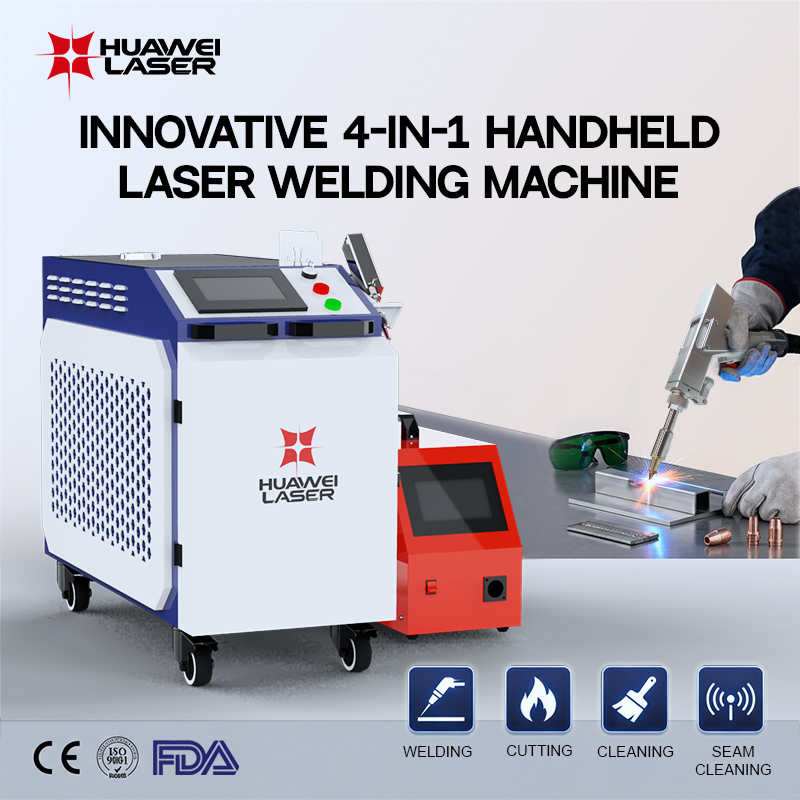
Choose a handheld laser welder of the appropriate specifications based on the thickness of the stainless steel material: for stainless steel less than 3mm thick, choose a 1500W handheld laser welder; for stainless steel 5mm thick, choose a 2000W handheld laser welder; for stainless steel 7mm thick, choose a 3000W handheld laser welder;
Focus on the three core components of the handheld laser welder: The three core components of a handheld laser welder are the laser, the water cooling system, and the handheld welding gun. Among the many available options, the HUAWEI laser welder is the first choice for stainless steel welding.