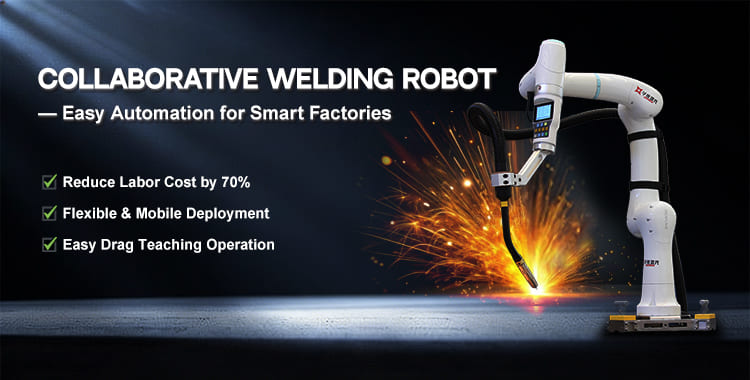

How Collaborative Welding Robots Increase Productivity in Small Factories
Small factories across metal fabrication, auto parts and hardware processing industries are trapped in common operational bottlenecks including skilled welder shortages, inconsistent welding quality and rigid traditional production modes. Most small factories lack sufficient space and budget to deploy large-scale fixed industrial welding equipment, making flexible and cost-effective automation upgrades a top priority. Collaborative Welding Robot stands out as a perfect match for small factory production conditions due to compact structure, simple installation and low deployment threshold. Small factories can complete layout adjustment and equipment debugging of Collaborative Welding Robot within one working day, without reconstructing original production workshops or arranging professional technical teams for long-term programming.
Productivity improvement in small factories relies heavily on stable working hours and standardized operation procedures, and Collaborative Welding Robot brings revolutionary changes to daily welding workflows. Traditional manual welding is easily affected by worker fatigue, mood and proficiency, leading to uneven welding speed and frequent defective products. Collaborative Welding Robot maintains fixed welding angle, stable moving speed and accurate arc length all the time, controlling welding error within micron level and greatly reducing product scrap rate. Collaborative Welding Robot supports 24-hour continuous cyclic operation without rest time, holiday arrangement and skill training investment required by manual welders. Multiple practical cases prove that small factories equipped with Collaborative Welding Robot can lift daily welding output by 40% to 60%, effectively solving order backlog and delivery delay problems.
Flexible production adaptability is another core advantage that makes Collaborative Welding Robot indispensable for small factories with multi-variety and small-batch orders. Small factories often need to switch processing styles and workpiece specifications frequently to meet personalized customer demands, while traditional welding equipment requires long-time parameter resetting and mold replacement. Collaborative Welding Robot adopts drag-and-drop teaching and intelligent one-click programming design, ordinary production operators can complete program switching of different workpieces in half an hour without professional coding knowledge. Collaborative Welding Robot is compatible with MIG welding, TIG welding and laser welding multiple processes, covering hardware parts, metal frames and small auto accessories mainstream welding demands. Small factories can adjust production schedules freely according to market orders with the support of Collaborative Welding Robot, improving market response speed and comprehensive competitiveness.
Cost control is a key concern for small factory operation, and Collaborative Welding Robot helps small factories realize double savings in labor cost and operational consumption. Skilled welder salary and training cost keep rising year by year, and small factories also face the risk of worker turnover affecting production progress. One set of Collaborative Welding Robot can replace the workload of 1 to 2 skilled welders, cutting long-term labor expenditure by nearly 50%. Meanwhile, Collaborative Welding Robot optimizes welding energy consumption and welding material utilization, reducing protective gas loss and welding rod waste by about 20% compared with manual welding. The later maintenance cost of Collaborative Welding Robot is far lower than large industrial welding machines, and the average investment return cycle of small factory deployment is controlled within 6 to 12 months.
The wave of industrial automation is sweeping small and medium manufacturing fields, and Collaborative Welding Robot has become a core tool for small factories to achieve productivity upgrading and intelligent transformation. Collaborative Welding Robot not only solves labor shortage and quality instability pain points, but also optimizes production space utilization and standardizes overall production management. More small factories begin to recognize the value of intelligent welding automation, and Collaborative Welding Robot gradually becomes standard configuration for new production line layout and old workshop renovation. With continuous technological iteration, Collaborative Welding Robot will integrate more intelligent perception and automatic parameter adjustment functions, further lowering deployment difficulty and expanding application scenarios. Small factories that take the lead in deploying Collaborative Welding
Robot will gain stable quality advantage, efficient delivery capability and lower production cost, occupying a more favorable position in the increasingly competitive manufacturing market.