

Why Does Laser Welding Beat TIG and MIG in Real Fabrication Production?
Metal fabrication shops constantly seek higher efficiency. Traditional methods like TIG and MIG have served industries for decades, but modern demands require faster turnaround. A laser welding machine offers a revolutionary alternative to transform manufacturing workflows.
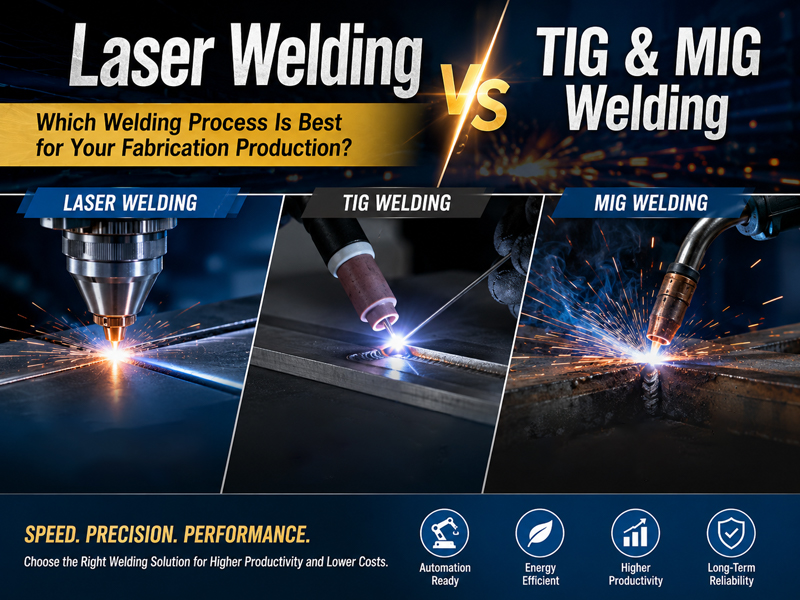
Laser Welding Machine vs MIG Welding
While TIG welding focuses on precision, MIG welding is widely recognized for high deposition rates and excellent performance in structural fabrication. For many years, MIG welding has been the preferred solution for construction equipment, heavy steel fabrication, trailers, agricultural machinery, and large industrial frames.
However, a laser welding machine has introduced a new level of efficiency for manufacturers producing thin to medium-thickness metal components.
The biggest difference lies in how heat is transferred into the material. MIG welding generates a broad arc and continuously feeds filler wire into the joint. A laser welding machine, on the other hand, concentrates energy into a narrow weld zone, allowing much faster travel speeds while keeping surrounding material cooler.
Why a Laser Welding Machine Improves Overall Production Efficiency
Purchasing a laser welding machine is not simply an equipment upgrade. For many factories, laser technology changes the entire production workflow.
Instead of evaluating welding speed alone, manufacturers should consider every stage of production, including material preparation, welding, grinding, polishing, inspection, and assembly.
Faster Production Cycles
Higher travel speeds allow operators to complete more parts in the same working hours.
For medium-volume and high-volume production, even small reductions in welding time can significantly increase annual output.
Many manufacturers report noticeable improvements in delivery time after introducing a laser welding machine into production.
Lower Labor Costs
Labor shortages continue to challenge manufacturers worldwide.
Compared with traditional TIG welding, a handheld laser welding machine is easier to learn because operators do not need to coordinate filler rod movement, torch angle, and foot pedal control simultaneously.
Shorter training periods allow companies to build skilled production teams more quickly while maintaining stable weld quality.
Reduced Post-Processing
Grinding and polishing often represent hidden production costs.
Because a laser welding machine produces cleaner weld seams with minimal spatter, manufacturers can reduce secondary finishing operations.
Typical benefits include:
Less grinding
Less polishing
Lower abrasive consumption
Reduced labor hours
Faster shipment
For decorative stainless steel products, reduced finishing time often becomes one of the biggest contributors to overall cost savings.
Better Product Consistency
Consistency is increasingly important for automated manufacturing.
Every weld should meet the same quality standard regardless of operator experience.
A laser welding machine provides stable energy output and repeatable welding parameters, allowing factories to maintain consistent weld penetration and appearance across large production batches.
Higher consistency also reduces product rejection and warranty claims.
Real Factory Applications
A laser welding machine has become an important production tool across many industries.
Common applications include:
Stainless Steel Fabrication
Restaurants, hotels, hospitals, and commercial kitchens require stainless steel equipment with smooth surfaces and attractive welds.
A laser welding machine produces narrow weld seams that require very little polishing, making stainless steel fabrication faster and more cost-effective.
Sheet Metal Manufacturing
Electrical cabinets, switch boxes, telecom enclosures, and server cabinets often use thin sheet metal.
Because a laser welding machine minimizes heat distortion, assembled products maintain higher dimensional accuracy.
Automotive Components
Automotive manufacturers increasingly use robotic laser welding machines for seat frames, battery enclosures, exhaust systems, and structural components.
High welding speed and excellent repeatability support continuous production.
Metal Furniture
Office furniture, shelving systems, lockers, and display racks all benefit from cleaner weld appearance and reduced finishing work.
A laser welding machine helps manufacturers improve both productivity and product quality while lowering labor costs.
Medical Equipment
Medical devices demand extremely clean welds and precise dimensional control.
A fiber laser welding machine is widely used to manufacture stainless steel medical equipment because laser technology produces minimal contamination and excellent weld consistency.
How to Choose the Right Laser Welding Machine
Selecting the right laser welding machine depends on material type, material thickness, production volume, and future automation plans.
Best for:
Daily sheet metal fabrication
Stainless steel products
Electrical cabinets
Metal furniture
Kitchen equipment
Advantages:
Excellent balance between speed and cost
Stable welding performance
Suitable for most fabrication businesses
Best for:
Medium-thickness materials
Continuous production
Heavy-duty fabrication
Industrial manufacturing
Advantages:
Faster welding speed
Deeper penetration
Higher productivity
3000W Fiber Laser Welding Machine
Best for:
High-volume production
Thick metal applications
Automated production lines
Robotic welding systems
Advantages:
Maximum productivity
High penetration capability
Excellent compatibility with industrial automation
Why Choose Huawei Laser?
Huawei Laser has focused on industrial laser equipment for more than 10 years, providing reliable solutions for manufacturers worldwide.
Every laser welding machine is designed for stable performance, easy operation, and long service life.
Conclusion
As manufacturing continues to move toward automation and higher efficiency, the laser welding machine has become an increasingly valuable investment for modern fabrication businesses. Compared with traditional TIG and MIG welding, a laser welding machine offers faster welding speeds, lower heat distortion, cleaner weld seams, and significantly reduced post-processing.
While TIG welding remains an excellent choice for highly skilled manual work and MIG welding continues to perform well in heavy structural fabrication, a laser welding machine provides clear advantages for sheet metal processing, stainless steel fabrication, electrical cabinets, metal furniture, automotive components, and many other precision manufacturing applications.
Rather than focusing solely on equipment cost, manufacturers should evaluate the entire production process—from welding speed and labor efficiency to finishing requirements and long-term operating expenses. In many cases, investing in a laser welding machine leads to higher productivity, better product quality, and a stronger return on investment over time.