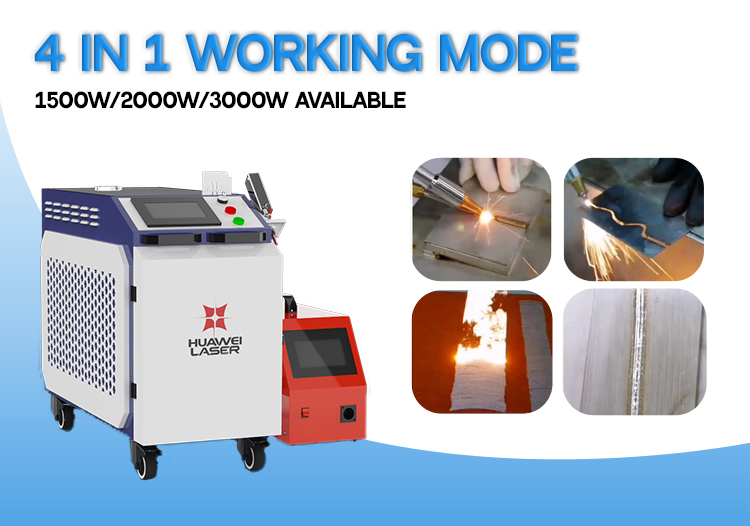

Tips for Welding Aluminum Alloy with a Handheld Laser Welding Machine
The Handheld laser welding machine has become an increasingly popular solution for aluminum alloy processing because a Handheld laser welding machine provides concentrated energy density, smaller heat-affected zones, and cleaner welding seams compared with traditional TIG welding and MIG welding methods. Manufacturers planning to improve aluminum alloy welding quality should fully understand the key precautions before operating a Handheld laser welding machine.
1. Surface Cleaning Before Aluminum Alloy Welding
Aluminum alloy surfaces usually contain oxide films, oil stains, dust, and moisture. Aluminum oxide has a melting point much higher than aluminum alloy itself. If operators directly use a Handheld laser welding machine without cleaning the aluminum alloy surface, welding pores, incomplete penetration, and unstable weld seams may appear.
Professional manufacturers recommend using alcohol cleaning, mechanical polishing, or stainless-steel wire brushing before using a Handheld laser welding machine. Surface cleaning significantly improves welding stability and reduces welding defects during aluminum alloy processing.
2. Correct Power Settings for a Handheld Laser Welding Machine
Different aluminum alloy thicknesses require different laser power parameters. Thin aluminum sheets may suffer burn-through if the laser power is too high. Thick aluminum plates may experience insufficient fusion if the laser power is too low.
A Handheld laser welding machine normally achieves better welding results when operators carefully match power, wire feeding speed, and welding speed. Stable parameter adjustment helps the Handheld laser welding machine create smooth welding seams with reduced deformation.
Correct parameter testing before mass production can greatly improve welding efficiency and product consistency.
3. Shielding Gas Selection During Aluminum Alloy Welding
Shielding gas plays an important role during aluminum alloy laser welding. Argon gas remains the most common shielding gas for a Handheld laser welding machine because argon gas effectively prevents oxidation and improves weld seam brightness.
Poor shielding gas purity may lead to black welding marks, pores, and unstable welding quality. Many professional factories recommend high-purity argon above 99.99% for aluminum alloy applications involving a Handheld laser welding machine.
4. Heat Control and Deformation Prevention
Aluminum alloy transfers heat quickly. Excessive heat accumulation may cause deformation, collapse, or dimensional inaccuracies. A Handheld laser welding machine offers lower heat input than traditional arc welding, making a Handheld laser welding machine highly suitable for precision aluminum alloy fabrication.
Operators should maintain stable welding movement and avoid repeated welding in the same position. Intermittent welding methods and proper fixture positioning also help reduce thermal deformation during aluminum alloy processing.
Many sheet metal manufacturers choose a Handheld laser welding machine specifically because a Handheld laser welding machine minimizes post-polishing work and improves finished product appearance.
Global demand for lightweight manufacturing continues to increase across electric vehicle production, rail transit equipment, aerospace engineering, and stainless steel fabrication industries. A Handheld laser welding machine has become one of the fastest-growing welding technologies because a Handheld laser welding machine delivers higher precision, lower maintenance costs, and easier operation.
Companies seeking high-efficiency aluminum alloy welding solutions can evaluate advanced laser equipment from Huawei Laser Handheld Laser Welding Machine.